
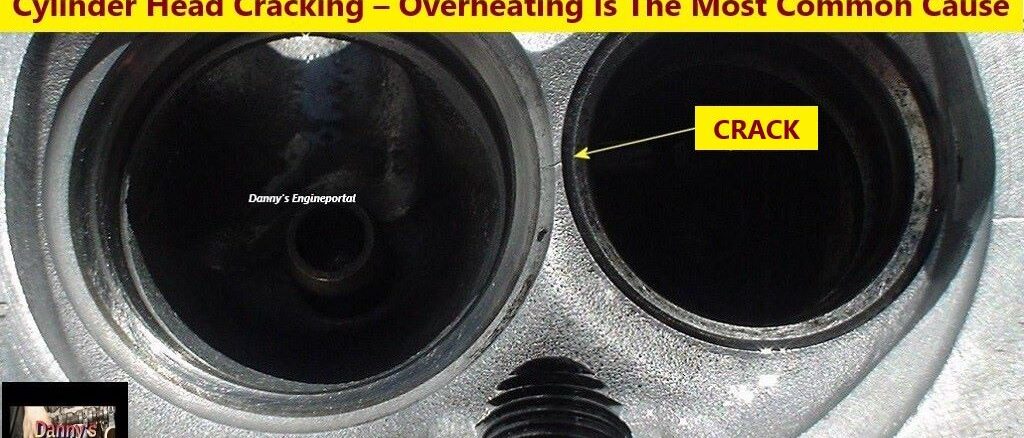
Cylinder head cracking can cause catastrophic damage to your engine.
In some cases the crack may be so severe, that replacing the whole engine is the only cure.
But most of the causes are all relatively simple and easy to prevent. Except in the case of mechanical parts failure through no fault of the operator.
So, cylinder head cracking can cause severe damage to the cylinders of the engine. When replacing either the cylinder head or the head gasket, make sure that you are using the correct parts.
The cylinder head used in combination with a head gasket, seals the cylinders of the engine. In the case of minor leaks, the cylinders may lose compression, causing misfires.
Cylinder Head Cracking In Different Places Can Cause Different Problems
Cylinder head cracks can leak antifreeze, oil or even compression. And, the leak can be internal or external.
Internal Cracking, In A Cylinder
These cracks are the easiest to find, because they usually have visible signs. White smoke coming out of the exhaust and engine misfires are common.
Internal Cracking, Not In A Cylinder
These cracks are bad, because they allow coolant to mix with oil. “White stuff” that looks like a milkshake on the dipstick or oil filler cap is common.
External Cracking, Not In The Engine
These cracks allow coolant to leak on to the ground. So, you should see it under your engine.
Even a brand new car can experience cylinder head cracking. As a result, you could have parts that have been installed incorrectly or weaknesses in the metal.
So, be certain to inspect any vehicle before you purchase it. And, check for incorrectly installed parts which includes the cylinder head gasket. Because wrong installation of this vital part can cause leaks.
It has become more common since car manufacturers use mixed metals in their engines. Many vehicles have a solid cast iron engine block, but an aluminum cylinder head. These two metals expand at different rates.
The Most Common Cause Of Cylinder Head Cracking Is Overheating
When a vehicle overheats, it puts stress on all of its metal components. This includes the cylinder head, which is often at the center of the heat. This can cause the head gasket to leak. Consequently, leading to cylinder head cracking, as the components warp and pressure begins to leak. All drivers should properly maintain their vehicles to prevent overheating.
Don’t Make It Worse Than It Is
Many drivers mistakenly pour cool water into the rad when their engine overheats. This is not a good idea. The rapid temperature change will cause cylinder head cracking, due to thermal stress. In a case where the cylinder head survives overheating, the driver may inadvertently destroy it by trying to do good.
Cylinder head cracking can also be caused by localized hot spots in the engine. These usually represent a failure in some portion of the cooling system. So, always make sure that hot spots are addressed. Especially, if your head gasket has failed recently.
Hot Spots Are Often Caused By:
- Uneven expansion of engine parts.
- Leaky hoses.
- Pre-ignition in the cylinders of the engine.
Keep Up With General Maintenance
To Prevent Overheating, Make Sure:
- Your rad is filled and in good condition, with a tightly sealed rad cap.
- That your thermostat is in good working order, and accurately reflecting the temperature.
- That you have no stretched belts or leaky hoses.
- The engine cooling fan is working effectively.
If your engine does overheat, stop and turn off the engine. Then allow it to cool completely before adding water. This can also help stop cylinder head cracking.
Diagnosing A Bad Head Gasket, By Looking For The Symptoms, Can Be Quite Misleading
A failed head gasket is NOT just a single thing. Head gaskets can fail in several different ways. Many failure types are possible, each with different symptoms. The symptoms that we may notice will depend on how and where the head gasket fails. Exhaust fumes immediately destroy inhibitors in the coolant, and set up an acid condition. And, may result in cylinder head cracking.
Leaking Head Gasket Side Effects
This is bad enough, but the coolant will then conduct electricity. This will eat away at the rad and other parts of the system from the inside. If the coolant should also enter the cylinders, the result will be a poorly running engine.
Combustion leaks in the valve area force coolant away during heavy acceleration. This causes excessive heat build up. When acceleration stops, the diverted coolant rushes back to the area, resulting in internal engine damage. If the cylinder head has warped, even slightly, it can cause leaks or cylinder head cracking.
In Summary: Cylinder Head Cracking
So, replacing the cylinder head is sometimes your only choice. But, if you are lucky, milling the head with a new head gasket could do the job.
Thank you!


