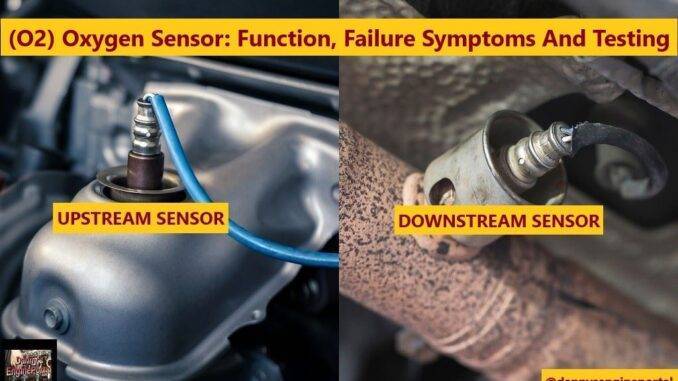
The, O2 Oxygen Sensor, measures the difference, between the amount of O2 in the exhaust gas. And, the amount of O2 in air.
With the O2 oxygen sensor information and other sources, the (ECU) can decide, whether the “air fuel” ratio, is rich or lean.
After that, the engine control unit (ECU), adjusts the amount of fuel, injected into the engine, to compensate for excess air or excess fuel. Subsequently, the objective is a compromise between power, fuel economy, and emissions.
However, the O2 oxygen sensor, is not able to measure, the air or the fuel entering the engine. Because, the O2 oxygen sensor, is located in the exhaust. And, that’s where it reads, the actual O2 content, in the exhaust. Depending on the year, make and model of your vehicle, you could have, one to four O2 sensors.
So, the ideal ratio for O2 and gasoline is 14.7:1. Which, slightly varies, depending on different types of fuel. Both, a rich and lean mixture, are bad for your vehicle, as well as for the environment.
How Does The (ECU) Read The Information From the O2 Oxygen Sensor
The information sent to the (ECU) is in the form of a voltage, above or below a preset amount. The base voltage is approximately 0.45 V (450 mV) DC., keeping the “air fuel” mixture, at the optimal ratio.
A voltage output, lower than the base amount around 0.2 V (200 mV) DC., would indicate a lean mixture.
However, a voltage output, higher than the base amount around 0.8 V (800 mV) DC., would indicate a rich mixture.
Having this information in real time, helps determine whether the “air fuel” ratio is rich or lean. So, if your O2 sensor fails to function properly, your engine management computer, cannot determine the “air fuel” ratio. Then, the engine is forced, to guess how much fuel to use. Resulting, in a polluted engine and a poorly running vehicle.
O2 Oxygen Sensor Failure Symptoms:
Check Engine Light (CEL)
A common sign of a faulty O2 sensor, indicating a problem with the engine’s emissions control system.
Poor Fuel Economy
A significant drop in fuel efficiency, as the engine struggles to maintain the correct “air fuel” mixture.
Rough Idle
An irregular or uneven engine idle, potentially accompanied by stalling or hesitation.
Engine Misfires
Occasional or continuous misfires, leading to reduced power and performance.
Engine Stalling
The engine may stall or hesitate, particularly during deceleration or at idle.
Black Exhaust Smoke
A sign of a rich (excess fuel) “air fuel” mixture, indicating a faulty sensor or other issues.
Rotten Egg Smell
A strong sulfur smell from the exhaust, suggesting excessive fuel or a problem with the catalytic converter.
Reduced Power/Performance
The engine may struggle to accelerate or maintain speed, especially at higher speeds.
Failed Emissions Tests
A faulty O2 sensor can cause the vehicle to fail emission tests, as the emissions are not being properly controlled.
Common Engine Trouble Codes For O2 Oxygen Sensors
It’s true that many of these symptoms, could be caused by various engine problems. But, the trouble code, from the O2 sensor will narrow it down quickly.
A trouble code (such as p0130, p0150, po132, p0141, po171, po420, po430 or others), is only the first step, in your diagnosis of the problem. It turns out that most of the issues that set O2 sensor codes, are not a result of a bad sensor.
So, over time it tends to become, fouled with carbon and sooty deposits. As a result, the element just simply erodes and wears down, like the electrode on a spark plug. They can also become fouled, if any silicone from grease or lubricants, makes its way to the exhaust stream. And, if any oil or coolant, make their way to the combustion chambers. Then, if the O2 sensor is worn out, it will lag in response time, or can just stop working.
What Can Cause The O2 Oxygen Sensor To Fail:
- Contaminated Fuel
- Silicone and Sealant ( Not Sensor Approved )
- Corrosion
- Leaks From Oil, Antifreeze and Fuel
- Leaded Fuel
So, over time, your O2 sensor can become caked, with byproducts of combustion. Including, sulfur, lead, fuel additives, and oil ash. As a result, this keeps your sensors from sending signals, to your engine’s computer. Also, using fuel that isn’t recommended for your vehicle, or low quality fuel can make your sensor fail faster.
O2 Oxygen Sensor Failure, Can Cause Catalytic Converter Meltdown
So, an O2 sensor failure, can lead to wrong readings of the exhaust gasses. As a result, the faulty O2 sensor can cause, a too rich or too lean condition. Too rich, and the catalyst can melt down. While, too lean, and the converter is unable to convert the hydrocarbons into safe elements. And, may not pass a state inspection.
The fuel that powers your vehicle, is meant to burn, in the combustion chamber only. So, any fuel that leaves the combustion chamber unburned, will enter the exhaust system. And, will combust, when it reaches the catalytic converter. As a result, this can super heat the converter, far above normal operating conditions and cause a meltdown.
Other Possible Things To Check Include:
Check For Vacuum Leaks
So, if your engine has a vacuum leak, the “air fuel” ratio in your engine, will be higher than 14.7:1. Consequently, this is also called, a “lean” mixture”. So, this ratio means that, there is too much air in your engine. And, as a result, the engine will run poorly or not at all. Finally, what is interesting about a vacuum leak is, it can look like something else.
The “air fuel” ratio, is very important in the proper workings of an engine. So, the proper amount of air has to be present, or else combustion efforts, are greatly affected. Also, a leak condition, can result in air that is not properly measured entering into the engine. As a result, that upsets the balance, and the result can be the engine having some problems.
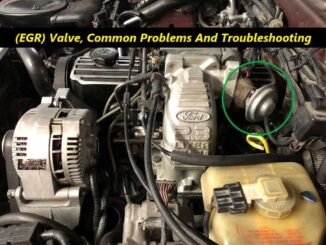
Check The (EGR) Valve
So, a stuck open (EGR) valve, will create a lack of O2 in the exhaust. Because, the recirculating exhaust, has all its O2 already burnt. Furthermore, the (ECM) sometimes uses, the O2 sensor to check for proper (EGR) operation. Then, sets a code if necessary.
So, be aware of the fact that, a vehicle might be running lean. Because, the (ECM) sees, a rich O2 sensor signal. Most often, due to a defective (stuck open) (EGR) valve. Since the (ECM) sees a rich signal, it will try to correct it, with a lean command. Then, try to lower the O2 sensors, high voltage signal.
Testing O2 Oxygen Sensor Voltage Signals:
- Start the engine and check the sensor voltage signals, on your voltmeter.
- The sensor voltage should cycle or fluctuate, within the 100 mV 900 mV (0.10 to 0.90V) range.
- Hence, this means the sensor, is operating properly.
- However, if the O2 sensor, only produces a low or high voltage signal.
- Then, you have an engine performance issue, or the O2 sensor stopped working.
To Verify Sensor Operation, Conduct The Next Two Tests
1, Test the O2 Oxygen Sensor Response, to a “Lean Fuel” Condition:
- First, disconnect the hose from the (PCV) valve, leading to the intake manifold.
- This will allow more air, to enter the engine. If you need to locate the (PCV) valve, consult your vehicle service manual.
- Check the sensor’s signal voltmeter reading. An O2 sensor interprets an increase in O2, as a fuel lean condition. Then, emits a signal, close to 200mV (0.20 V).
- If the sensor doesn’t respond accordingly or takes time to respond, the sensor isn’t working properly.
2, Test the O2 Oxygen Sensor Response, to a “Rich Fuel” Condition:
- Next, disconnect the plastic duct, from the air cleaner assembly on your vehicle.
- Block the duct opening, leading to the engine, with a clean rag. This will reduce, the amount of air going into the engine.
- Check the sensor’s signal voltmeter reading. An O2 sensor interprets, a decrease in O2, as a rich fuel condition. Then, emits a signal, close to 800mV (0.80 V).
- If the sensor doesn’t respond accordingly or takes time to respond, the sensor isn’t working properly.
If the O2 oxygen sensor in your vehicle, responded correctly to your tests. Then, you might have a problem with another component, affecting fuel economy.
So, as you can see, testing is way cheaper, than just replacing parts.
Conclusion
So, one of the most important sensors in modern vehicles, is the O2 sensor. Also, known as the O2 sensor, because O2 is the chemical formula for oxygen. The O2 sensor, monitors how much unburned O2, is present in the exhaust, as the exhaust exits the engine.
So, by monitoring O2 levels, the sensor provides, a way to measure the “air fuel” ratio. Finally, knowing the “air fuel” ratio, allows your engine to make any necessary changes. And, that ensure that your vehicle, runs like it should.