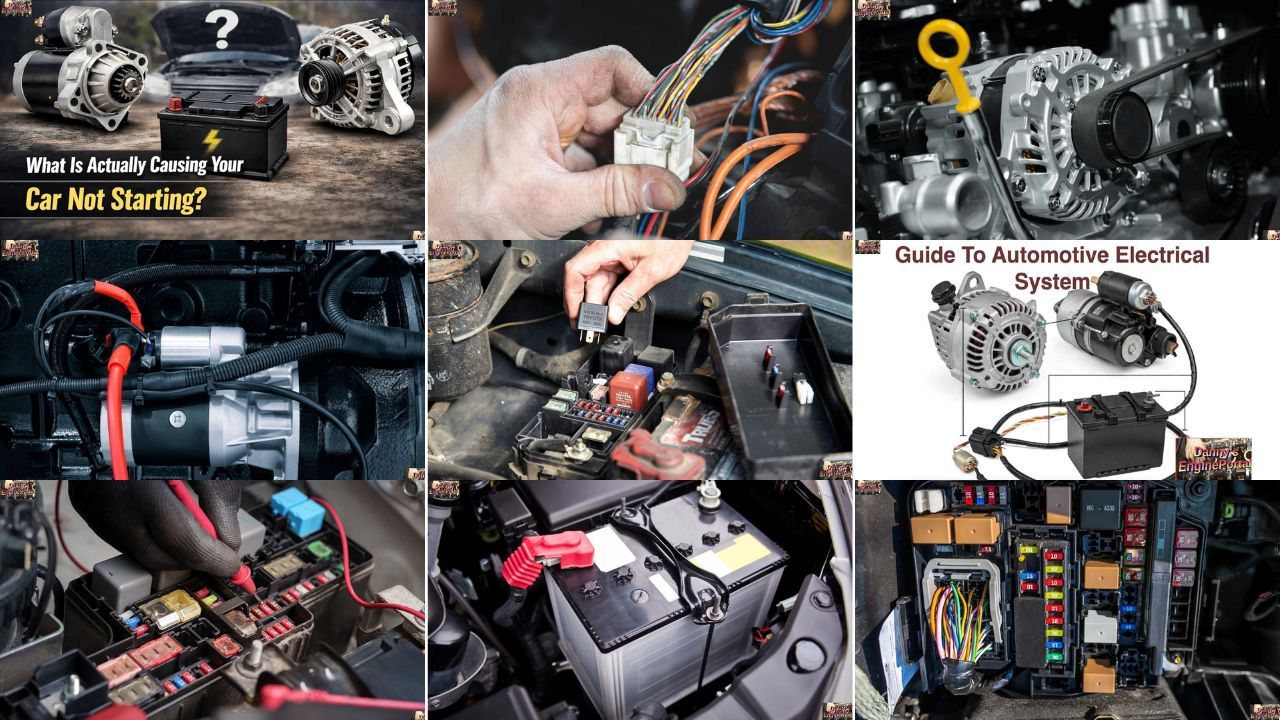
A car’s electrical system is a networked system comprised of three core components, the battery, alternator, and starter motor.
And they are supported by a distribution system of wires, fuses, relays and switches.
It provides power to essential systems, including the ignition, lighting, and HVAC.
The electrical system manages charging and power distribution when the engine is running.
Core Components:
- Battery (12V): Acts as the heart of the system, storing electricity to start the engine and powering electronics when the engine is off.
- Alternator: Charges the battery and provides electricity to all components when the engine is running.
- Starter Motor: A powerful motor that uses electric energy from the battery to turn the engine over, starting the vehicle.
Supporting Components:
- Ignition Switch/System: Initiates the starting sequence, often creating high voltage (\(20\text{ kV} – 40\text{ kV}\)) to turn the engine.
- Wiring/Harness: Conducts electricity throughout the vehicle.
- Fuses: Protect circuits from damage by breaking the circuit in case of an overload.
- Relays: Switches that manage high-current flow to specific components (e.g., HVAC, lights).
- Voltage Regulator: Ensures the alternator maintains a consistent voltage output to prevent overcharging.
Key Subsystems:
- Charging System: Includes the alternator, voltage regulator, and indicator lights/gauges to ensure proper charging.
- Starting System: Comprised of the battery, starter, and ignition switch.
- Electrical Loads: All powered parts, such as headlights, dashboard, and radio.
Related Posts
- Alternator or Battery Failure: How to Diagnose and Save Money
- Automotive Fuses: Know How They Work and Why They Blow
- Automatic Shutdown (ASD) Relay – Function – Failure – Testing
- Car Battery – Know What Can Go Wrong, Before You Disconnect It
- Cooling Fan Relay – What Does It Do – Failure Symptoms – Testing
- Engine Not Cranking Over: One Of The Easiest Problems To Solve
- Engine Won’t Start: Causes, Diagnosis & Fixes
- Fuel Pump Relay – Function – Failure – Testing Procedures
- Ignition Switch: Understanding its Importance in Vehicle Security
- Push Button Start Troubleshooting: Why Won’t the Engine Crank?
- Starter Motor Problems (Symptoms, Causes & Diagnosis)