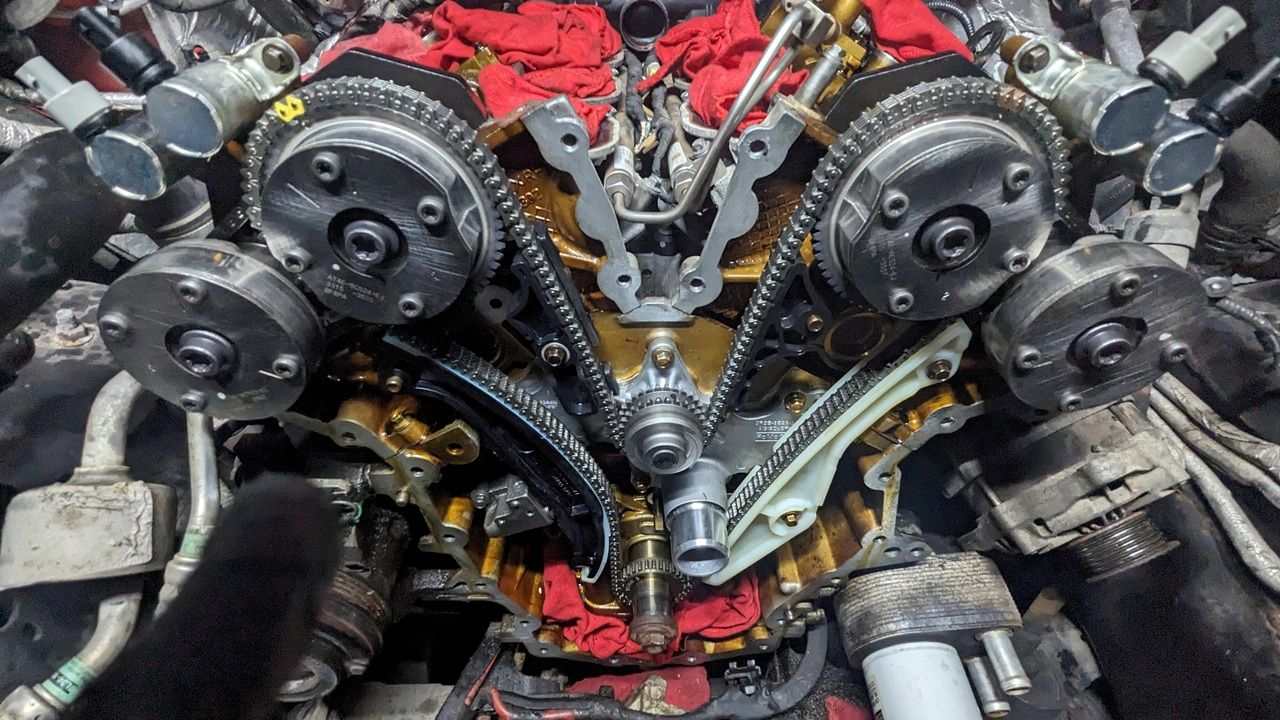
The Engine Front End is a subsystem located on the pulley side of the engine. Its primary functions are distributing power from the crankshaft to vital engine accessories and operating the timing systems that dictate how the engine breathes
Three subsystems actually make up the complete engine system. Engine Top End, Engine Bottom End and Engine Front End.
These parts are supported by essential subsystems—lubrication, cooling, fuel, and ignition—that ensure smooth operation, optimal temperatures, and precise combustion timing.
The engine front end is basically everything on the front of the engine.
Engine Front End
Timing Gears (gear to gear) Drive. Timing gears are two helical gears on the front of engine that operate the engine camshaft.
Chain and Two Sprockets. The timing chain transfers power from the crank sprocket to the cam sprockets.
Timing Chain Tensioner. A chain tensioner can be used to take up excess slack as the chain and sprockets wear. A chain guide may be needed to prevent chain slap. Auxiliary chain and sprockets may be used to drive the engine oil pump, balancer shafts, and other units on the engine. Oil slinger helps spray oil on the timing chain to prevent wear.
Timing Belt. Teeth are in the inside of the belt. They mesh with the teeth on the outside of the crank and cam sprockets. A belt sprocket normally has square teeth.
Timing Belt Tensioner. A timing belt tensioner is a wheel that keeps the timing belt tight on its sprockets. Timing belt sensors detects excessive tensioner extension and timing belt wear and stretch.
Tensioner.
A tensioner is a device that maintains constant, optimal tension on a belt or chain to prevent slippage. These components, which include spring-loaded or hydraulic pulleys, are vital for powering accessories like the alternators, water pumps and timing belts..
Crankshaft Pulleys. They run the alternator, power steering pump, air conditioning compressor, air injection pump, and other devices.
Harmonic Balancer. A harmonic balancer (or crankshaft damper) is a crucial engine component mounted to the front of the crankshaft that reduces torsional vibrations and prevents engine damage. It features a metal hub and outer ring bonded by rubber, which absorbs engine vibrations, and often serves as a pulley for accessory drive belts
Engine Balance Shafts. The balance shaft has bob weights that spin in the opposite direction of crankshaft rotation. This cancels out torsional vibrations created by the crankshaft, providing a smoother engine idle.
Intake Manifold.
It is a metal casting or plastic part casting that bolts over and covers intake ports on the cylinder head.
Exhaust Manifold. It bolts to the cylinder head, over the exhaust ports.
Valve Cover. Also called rocker cover or cam cover on OHC engines, is a thin housing over the top of the cylinder head. It simply keeps valve train oil spray from leaking out if the engine.
Engine Gaskets. They prevent pressure, oil, coolant, and air leakage between engine components. They include; cylinder head gasket, valve cover gasket, oil pan gasket, and front cover gasket. Also the thermostat housing gaskets, intake and exhaust manifold gaskets, etc.
Oil Pan. The oil pan, normally made of thin sheet of metal or aluminum, bolts to the bottom of the engine block. It holds an extra supply of oil for the lubrication system. It also has a screw-in drain plug for oil changes. The sump is the lowest area in the oil pan where oil collects.
Oil Pump. So an oil pump is a critical engine component that circulates motor oil under pressure to bearings, pistons, and the camshaft, ensuring lubrication, cooling, and hydraulic power for components like valve lifters. Located within the oil sump, they prevent engine failure by maintaining oil pressure.
Related Posts
- (VVT) Variable Valve Timing: Enhancing Engine Performance
- Belts, Hoses, Tensioners and Pulleys: Keep The Coolant Flowing
- Engine Timing Belt – Sets The Mechanical Heartbeat Of The Engine
- Ignition Timing – The Spark Plug Has To Fire At The Proper Time
- Timing Belt Basics – Avoid the Unexpected Cost of Engine Damage
- Timing Belt Failure: Causes, Symptoms, and Solutions
- Timing Belts – Chains Or Gears, All Do The Same Thing, Differently
- Timing Belts: Connect Parts Together, To Operate In Sequence
- Variable Valve Timing (VVT) – Benefits & Advantages Explained
- Variable Valve Timing (VVT) – Function And Its Advantages
- Water Pump And Timing Belt Replacement – Tips And Instructions