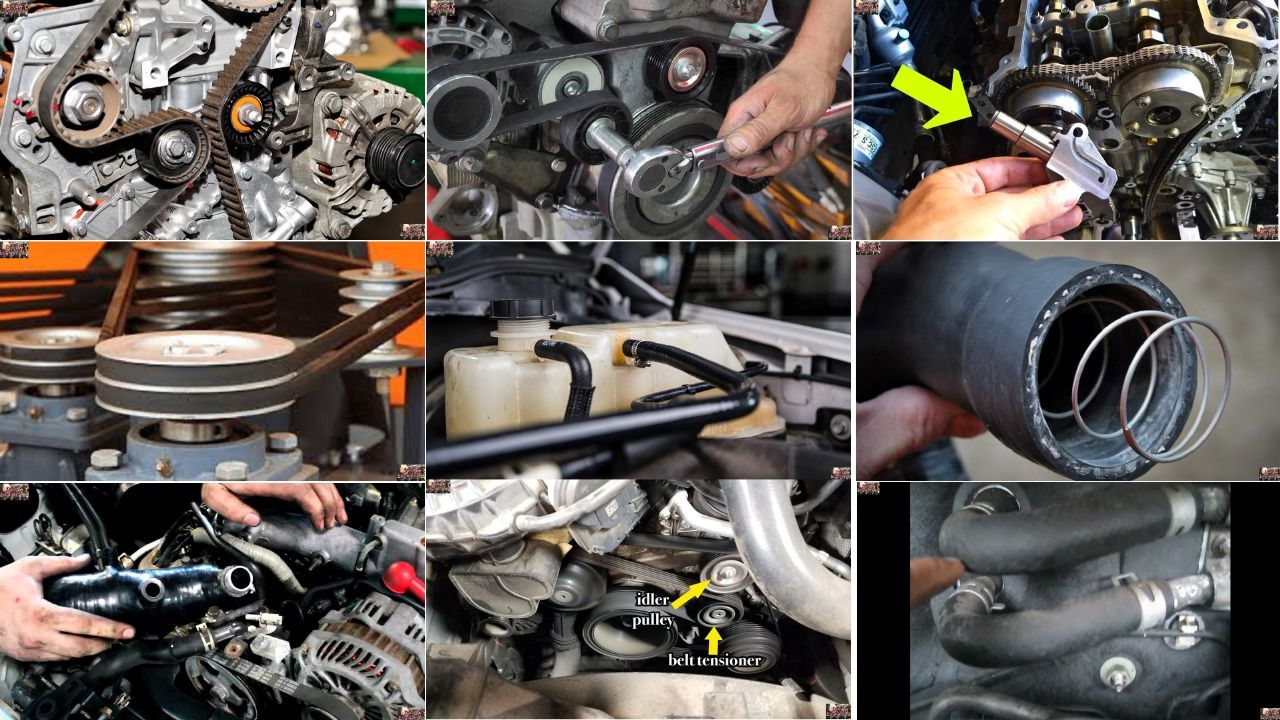
Key components of automotive belt, hose, and tensioner systems include the serpentine belt, timing belt, radiator hoses, and automatic tensioners with pulleys.
Maintaining belts, hoses, tensioners, and pulleys is critical for engine performance, as heat and vibration cause wear that can lead to belt snaps, overheating, or failure.
These parts ensure the engine’s accessories (alternator, water pump, power steering) receive power, maintain proper cooling, and keep drive belts properly tightened to avoid system failure.
Always replace belts, hoses, tensioners and pulleys together to prevent premature failure of new parts.
Belts
- Serpentine Belt: A long, continuous belt that drives multiple peripheral devices such as the alternator, power steering pump, water pump, and air conditioning compressor.
- Timing Belt: Connects the crankshaft to the camshaft, synchronizing engine valve timing.
- V-Belt: An older type of belt used for driving individual accessories.
Hoses
- Radiator Hoses: Transfer coolant between the engine and the radiator.
- Heater Hoses: Move hot coolant to the heater core for cabin heating.
- Turbocharger/Intercooler Hoses: Specialized hoses for turbo systems.
Tensioners and Pulleys
- Automatic Belt Tensioner: Maintains proper tension on the serpentine belt via an internal spring.
- Tensioner Pulley: A bearing-supported wheel on the tensioner that rides on the belt.
- Idler Pulley: A fixed pulley used to guide the belt and adjust the belt path.
- Tensioner Arm/Bracket: Holds the tensioner and pulley in place on the engine.
- Decoupler Pulley: Allows the alternator to “free-wheel” when the engine slows down, reducing belt stress.
Related Posts
- Automatic Belt Tensioner – Function – Failure Symptoms – Testing
- Coolant Recovery Tank: What Does It Do and Why Do You Need It
- Cooling System Components Explained in Detail
- Engine Front End Explained: Components and Functions
- Engine Timing Belt – Sets The Mechanical Heartbeat Of The Engine
- Serpentine Belt: Function – Failure Signs – Easy Replacement
- Timing Belts – Chains Or Gears, All Do The Same Thing, Differently
- Timing Belts: Connect Parts Together, To Operate In Sequence
- Timing Belt Basics – Avoid the Unexpected Cost of Engine Damage
- Timing Belt Failure: Causes, Symptoms, and Solutions
- Water Pump And Timing Belt Replacement – Tips And Instructions