Engine testing is something you would do to check the overall condition of an engine or engine part.
Sometimes you are doing them to find specific problems. And other times you are looking for a failed or damaged system or part.
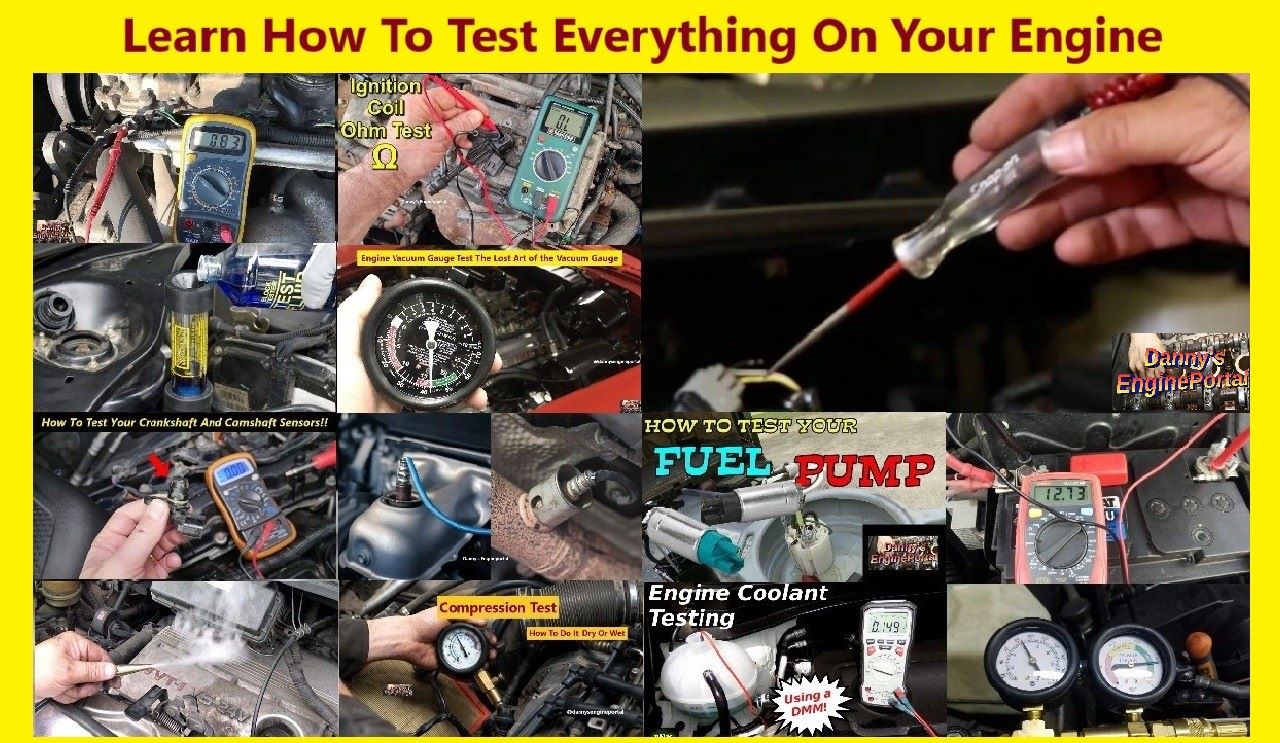
Some of these tests include: compression testing, cylinder leak down testing and power balance testing. And more comprehensive tests like: vacuum testing and fuel pump diagnostics.
Engine testing is really not that hard to do. And it is the best way to diagnose problems.
Automotive Engine Testing Procedures and Diagnostics:
- Automatic Shutdown (ASD) Relay Testing
- Bubble Test: Used in Conjunction, With a Cylinder Leak Down Test
- Camshaft Position Sensor Symptoms, Testing & Replacement (CMP Guide)
- Catalytic Converter Testing
- Compression Testing
- Cooling Fan Relay Testing
- Crankshaft Position Sensor Symptoms, Testing & Replacement (CKP Guide)
- Cylinder Leak Down Testing
- Cylinder Power Balance Testing
- Electric Fuel Pump Testing
- Engine Coolant Testing
- Engine Vacuum Testing
- Evaporative Emission System (EVAP) Testing
- Idle Air Control Valve (IAC) Testing
- Noid Light Testing
- Oxygen Sensor (O2) Diagnostic Testing
- Running Dynamic Compression Testing
- Vacuum Leak Detection: How to Find & Fix Vacuum Leaks Safely
- Wet Compression Testing
Automotive engine testing and diagnostics involve a 7-step strategy-based approach—combining computer data analysis, electrical testing, and mechanical inspection to isolate faults efficiently and prevent costly part replacements.
1. Verification & Preliminary Checks
- Customer Interview: Note the exact symptoms (sounds, smells, power loss, dash lights) and under what conditions they occur.
- Visual Inspection: Roughly \(10\%\) to \(30\%\) of engine problems are found by simply popping the hood. Check for loose or cracked hoses, frayed belts, low fluid levels, and disconnected wires.
2. On-Board Diagnostics (OBD-II) Scan
- Code Retrieval: Plug a diagnostic scan tool into the OBD-II port (usually located under the driver’s dashboard) to pull Diagnostic Trouble Codes (DTCs) from the Engine Control Unit (ECU).
- Live Data Monitoring: Observe real-time parameters like coolant temperature, RPM, fuel pressure, and oxygen sensor data to see if sensors are outputting valid data.
3. Mechanical & Physical Integrity Tests
If data points to an internal issue, mechanics confirm it with physical testing:
- Compression Test: Measures the cylinder’s ability to seal and compress air/fuel. Low compression usually means worn piston rings, burnt valves, or a blown head gasket.
- Cylinder Leak-Down Test: Forces compressed air into a cylinder to pinpoint exactly where pressure is escaping (listen at the tailpipe, intake, or oil dipstick tube).
4. Air, Fuel, & Ignition System Diagnostics
The “fire triangle” for an engine requires air, fuel, and a spark at the right time:
- Fuel Testing: Check fuel rail pressure and injector pulse width to ensure the correct volume of fuel is being delivered.
- Ignition & Electrical: Test for voltage drops in wiring circuits and evaluate spark output from the ignition coils.
5. Advanced Scope & Waveform Analysis
- Oscilloscope Testing: A lab scope is used to view ultra-fast electrical signals, such as oxygen sensor waveforms, crankshaft/camshaft sensor timing, and primary/secondary ignition patterns.
6. Repair & Verification
- Repair: Address the root cause (e.g., replacing a bad sensor, sealing an air leak, or performing a software flash).
- Verify Repair: Clear all DTCs and test-drive the vehicle to ensure the initial concern has vanished and the check engine light remains off.
Related Posts